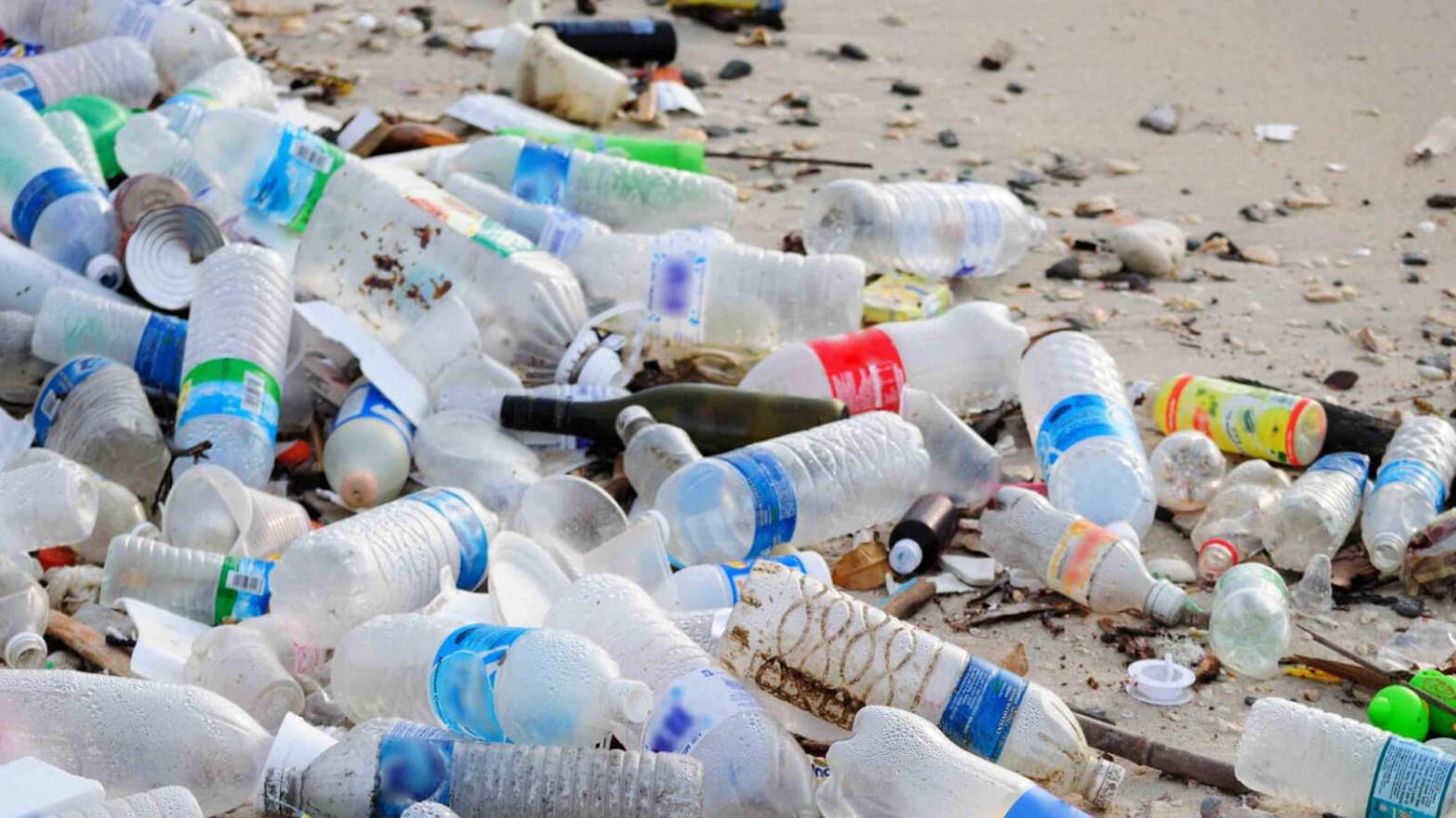
Everyone will agree over the fact that single use plastic is one of the main challenges for our ocean’s sustainability. Over the last two generations, the world has produced over 8bn tons of plastic, and it piles up, since it takes an average 450 years to decompose a plastic-made bottle. Therefore, we pay lots of attention on building a self-sustainable water system on the boat, not only for washing and personal hygiene, but also for drinking.

On any cruising journey, water management is an important topic, taking into account supplying possibilities, water-maker average output, water tankage, crew size etc. This is all the more true for high latitude sailing, where weeks can go-by between water refills, and where low sea temperature will degrade water-maker output by 10% for every 3°C water temperature drop.
Access to water becomes one of the key autonomy criteria. In high latitudes, there won’t be any 7-eleven around to make a boat refill of drinking water, and many docks are not equipped to deliver water to the passing cruiser. In winter time, it’s likely to be shut-off anyway, because of the freezing temperature.
Offsetting 70 to 100 liter per day
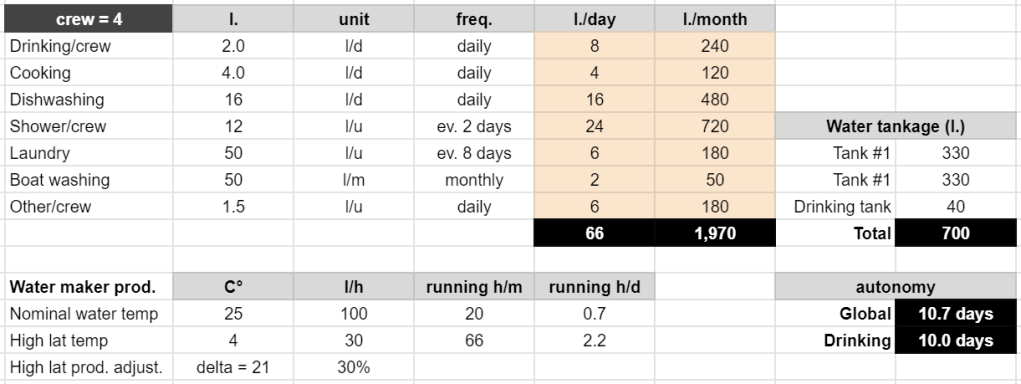
We compute the following needs:
- Drinking water: anything between 2 and 2.5 l/d per crew. It will be higher in hot conditions, and for active people.
- Shower: a very controversial topic between long and short hair people. Anyway, the minimum would be 7 l/u, and an agressive goal would be 12 l/u on average.
- Other personal use: 1.5 l/d per crew, but increasing when shower decreases
- Laundry: 50 l/u, so the trick here is to estimate the number of cycles/month, depending on the crew size.
- Cooking: we estimate an average 4 l/d.
- Dishwashing: not easy to estimate, and will depend on crew size. Our initial model is 10 l/d + 1 l/d per crew.
- Boat cleaning: 50 l/month
We built a basic model to help us estimate the average consumption per day, the kind of autonomy we’d get and the water-maker production goal. The first estimate is for an high latitude long range journey with a crew of 4, with very no restriction on water usage (no sea water for dishwashing, quick shower every other day):
- Daily consumption = 66 l.
- Boat autonomy = 11- days (10 days for drinking water)
- Water-maker load = 1h/d in nominal sea water temperature (25°C), but over 2h/d in high latitude waters.
With a crew of 6, the calculation goes:
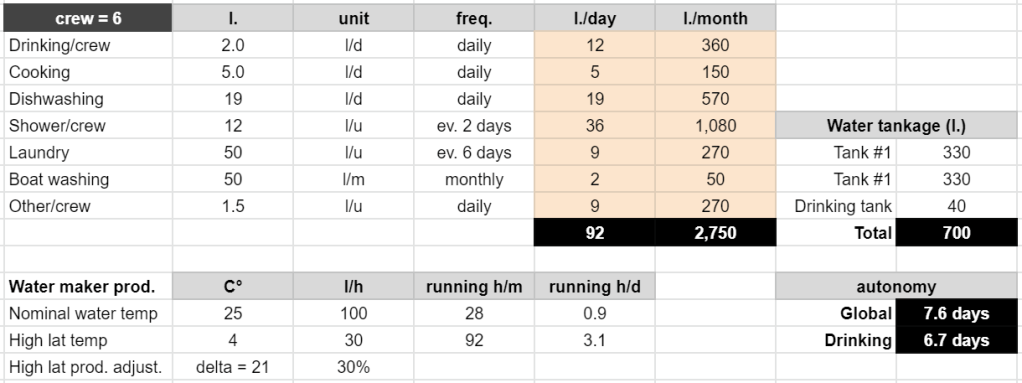
It is a clear conclusion that making water is a key topic on a long range journey. Initially we though the back-up water-maker would only be a fallback, but it appears we might end-up combining their use to match the average consumption needs, while sailing in high latitude areas with low sea temperature, .
Goal #1 – Making water
Dealing with cold sea water
Sailing in areas where the sea water temperature will be in the 2-5°C range, we need to take into account the impact on watermaker output.
Reverse osmosis watermaker systems are generally rated at 25°C. Variations in temperature influence a reverse osmosis water-makers performance for two reasons : (i) Water viscosity changes at different temperatures; the cooler water gets the viscosity (stickiness) of the water increases. (ii)
The water temperature influences the membrane element. Cold water causes the pores in the membrane to shrink. For every 3 degrees, the temperature drops below 25°C, the permeate output will decrease by 10%.
The drop in flow rate due to cold water temperatures can be offset to some degree by increasing the running pressure of the system. Every 5°C drop in water temperature can be offset with a 15% increase in running pressure to obtain the system rated permeate flow.
H2O on the go
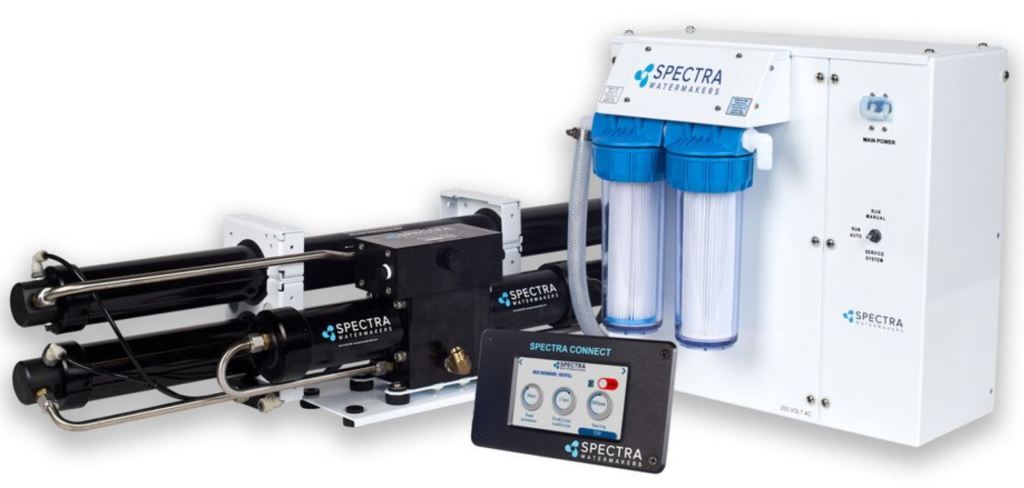
Few water-maker brands have the ability to increase the operating PSI to maintain the output, as water temperature decreases. Confirming H2O on the go analysis, here are Spectra’s numbers:
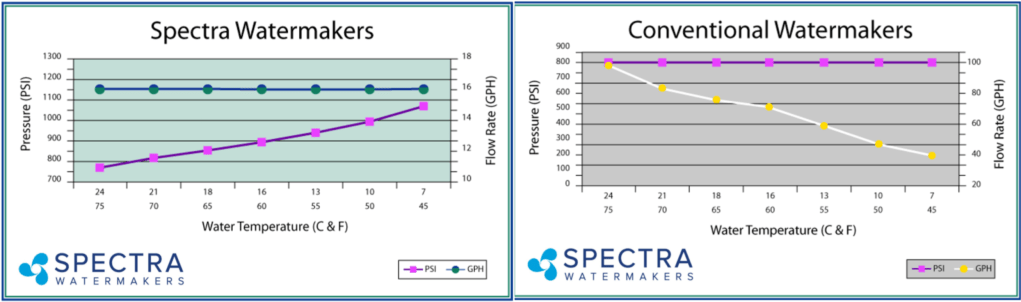
Spectra is able to perform this variable psi function while maintaining control on the energy consumption thanks to the use of the Clack pump, a hydraulic intensifier and energy recovery device. It provides enough pressure for reverse osmosis, but reduces energy consumption by up to 75% over conventional systems, by recycling the energy in the pressurized brine stream to boost the low pressure feedwater up to 800 PSI (55 Bar).

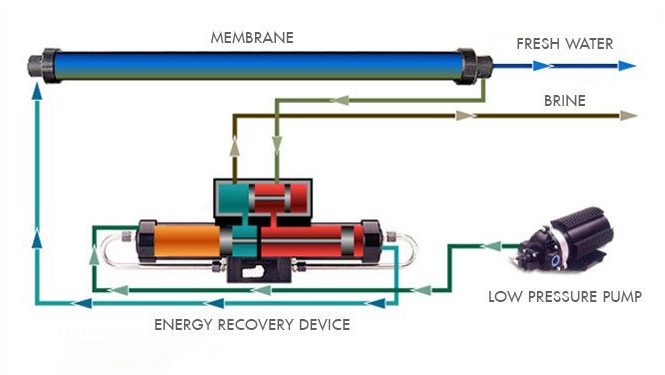
So for high latitude sailing, implying very cold sea water, there are two approaches for maintaining the water-maker output: either select a variable psi Spectra unit, with a smaller one as a backup, either run two similar units in parallels (one being the backup of the other).
Benchmark
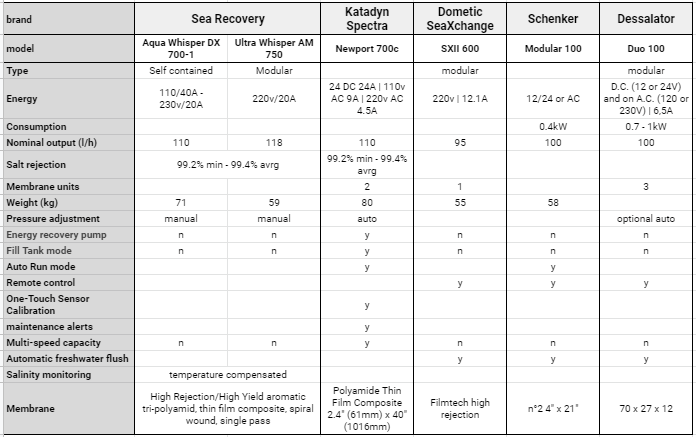
This being said, we benchmarked the most common brands, including Spectra:
- Dessalator Duo 100 (France)
- Dometic SeaXchange SXII-Series (USA)
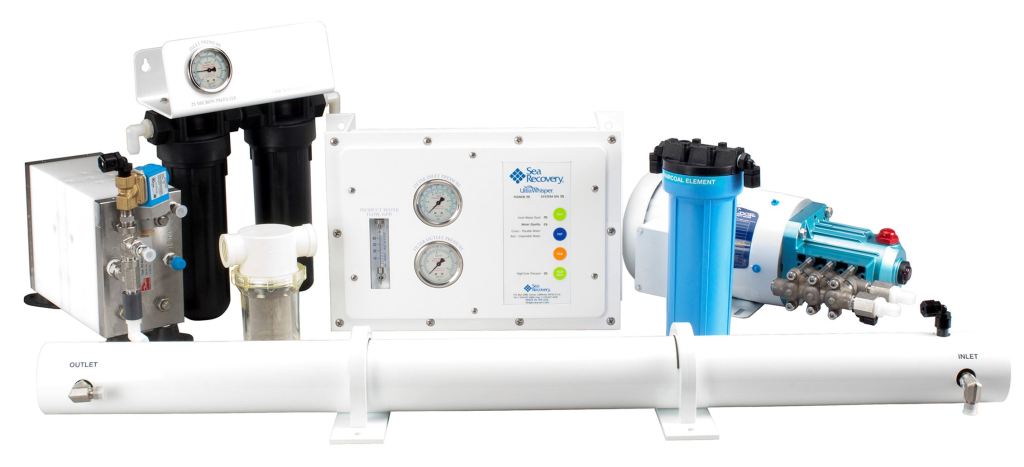
- Sea recovery AquaPro 700-1 (USA)
- Sea recovery Aqua whisper mini (USA)
- Spectra Katadyn Newport 700 (Switzerland)
- Schenker watermakers Modular 100 (Italy)

Schenke Modular 100 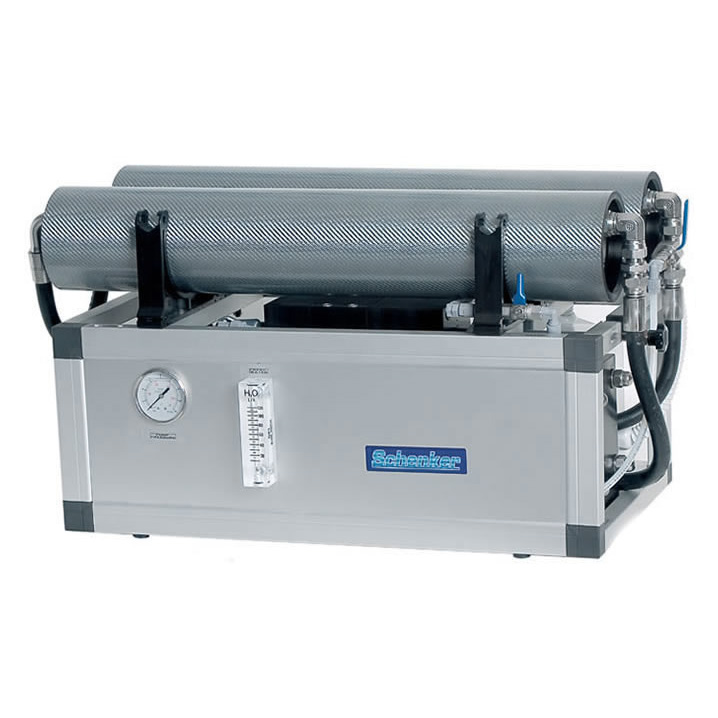
Schenke Modular 100
Goal #2 – Drinking water
Dedicated tank for drinking water
We definitely drop the PET-bottle drinking water habit, and there are many good reasons to do so, their environmental impact not being the least. The burden of carrying and storing them, on a 2l/d per crew basis, comes just behind.
With this in mind, we devised a specific water installation, using an unusual drinking water dedicated tank. This is something we have seen in a custom-built KM yacht, but appart from this, it seems to be an unorthodox water fitting, including on long range sailing boats.
- 40 to 60 liter dedicated stainless steel drinking water tank (316 grade, best over polyethylene, as it won’t tain the water with plastic taste).
- Smaller volume ensures that the water is frequently replaced and stays fresh.
- Can be filled in two different ways:
- Directly from the watermaker output, with overflow filling the main water tanks.
- Or through the boat dock inlet.
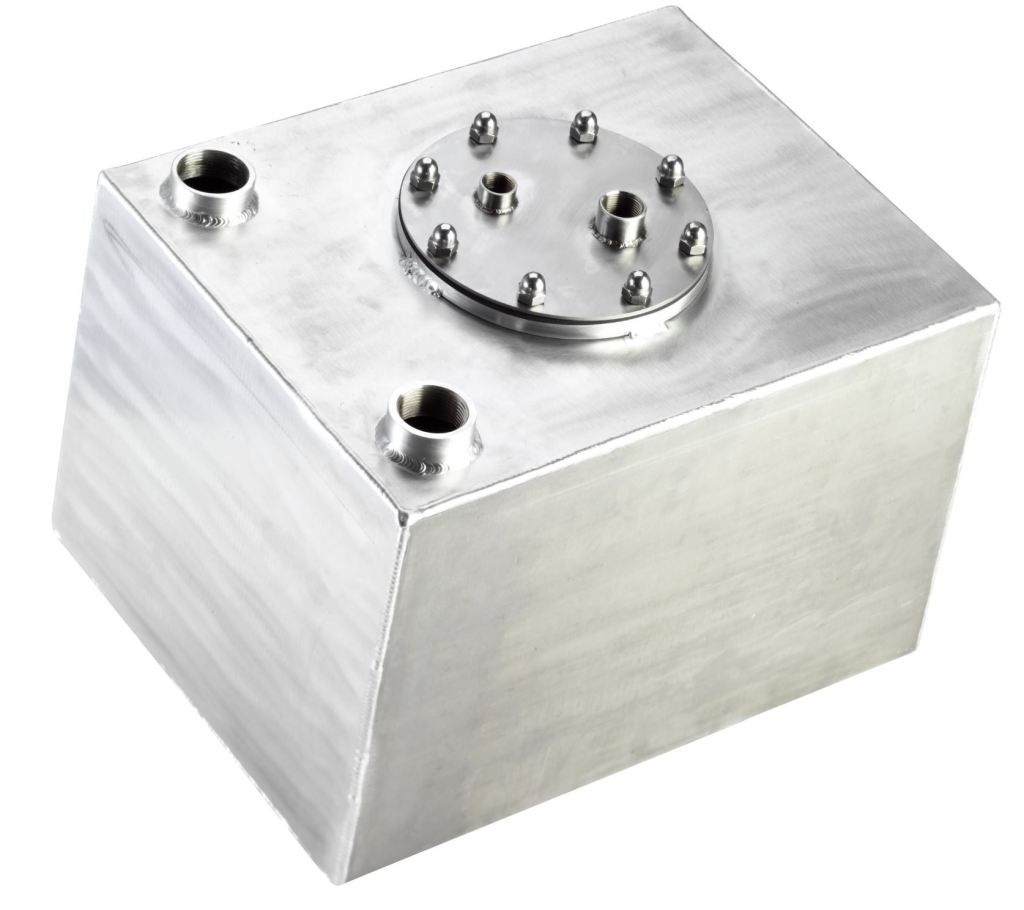
- The tank can be removed for cleaning, with a large opening
- Has a dedicated filter system for the drinking water
- And last a dedicated faucet in the galley
- As an additional benefit, we would use this water to rinse the watermaker membrane, as it would be chlorine-free (a hazard for the membranes), unlike most of the water we get on marina and harbor hoses.
Drinking water treatment
The water stored in the tanks will have various sources over time. It may come from a dock faucet (city water), running through different qualities of tubing system. The sanitation standard will differ from one place to another, and it will include a fair dose of chlorine, which is bad for the watermaker should it be used for rinsing the membranes. While the water made out from the water-maker is likely to be the purest, both chlorine and pesticide-free, in some circumstances it won’t be possible to use it, for instance on an extended stay in a harbor or a marina.
The following items needs to be considered to make the tank water drinkable:
- Viruses & bacteria: while some may be odorless, the sign will be when you notice a pungent odor coming from your tap.
- Cysts: Giardiasis is a gastrointestinal illness caused by the introduction of Giardia cysts from human or animal wastes into water supplies. The microscopic cysts are capable of surviving in cold water for several months. Cysts are easy to filter, given their larger size in comparison to those of bacteria and viruses (7-10 microns).
- Chlorine
- Dirt and sediment
- Pesticides, herbicides and solvents
- Foul tastes and odors
“Buy a filter or be a filter”
A marketing plot ?
Various solutions exist, based on filtering and UV radiation, and of course, and a mix of these would be highly recommended to lose the PET-bottles habit and start drinking from the boat tank.
- UV-Treatments
- InstantTrust Marine disinfects water by means of UV radiation
- Acuva Tech UV: eliminates bacteria, viruses and cysts, needs to be coupled with a pre-filter for chlorine, sediments, odor and taste. Specs: 12, 120 and 230 V | power consumption active 9W, standby 0.1W | Operating Pressure: 12-100 psi | dim 475 x 250 x 105mm | LED life-time ~1000h.
- Filters
- Seagull X-2KF Esprit: ecologically friendly (no chemical, no electricity or hold time), its technology removes all three classes of contaminants: microbiological, chemical and aesthetic. Spec RS-2SG purification cartridge capacity ~8000 l | flow rate 7.6 l/mn | 25-100 PSI. Link to Seagull’s EPA testing.
- Nature Pure QCII water filter: employs the same General Ecology’s Structured Matrix™ purification technology of the Seagull system (no chemicals or electrical connections) with best results against bacteria, cysts, and viruses. Spec Size: 228x76mm | Particle Retention: 0.4 micron | Flow Rate: 3.0 l/mn | cartrige capacity 2,000 liters | Operating Pressure: 20-100 psi.
- UV and filter combined
- InstantTrust Marine double Blue: water flows through the 5 micron filter and is then exposed to UV-C radiation. Spec : 35 x 18 x 12 cm | 12, 24, 120 and 230 V | Max power use 11W.
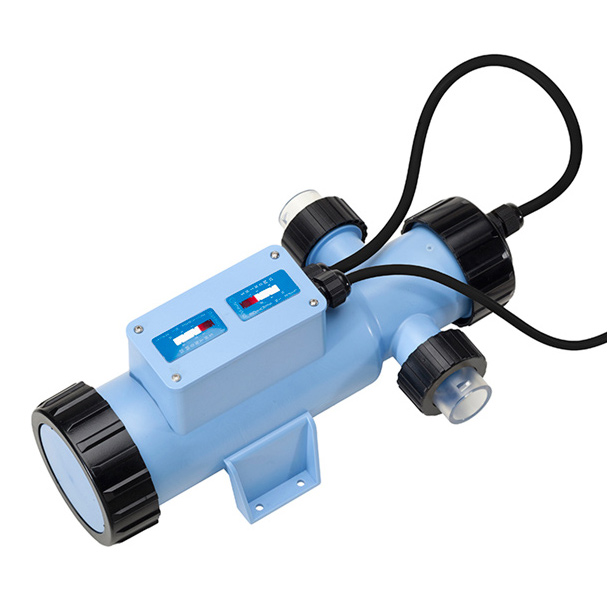
- InstantTrust Marine double Blue
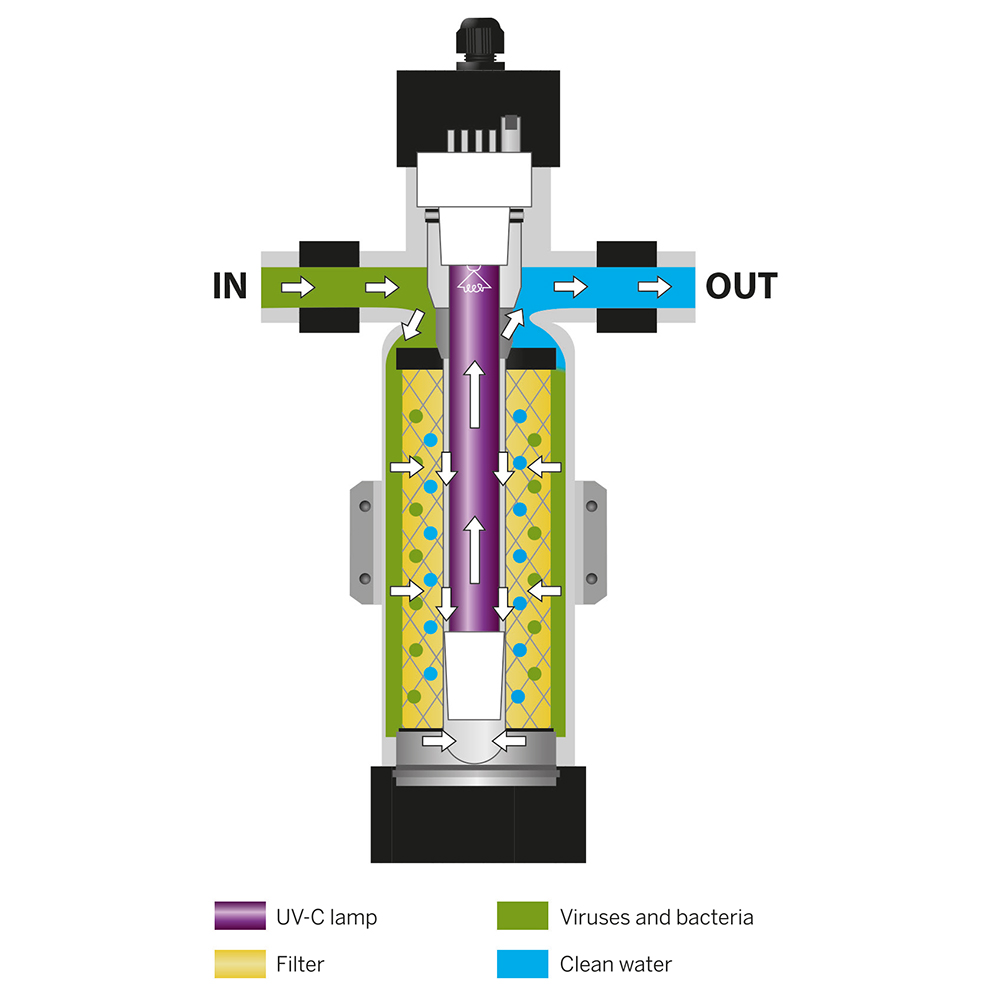
- InstantTrust Marine double Blue

- Seagull X-2KF Esprit
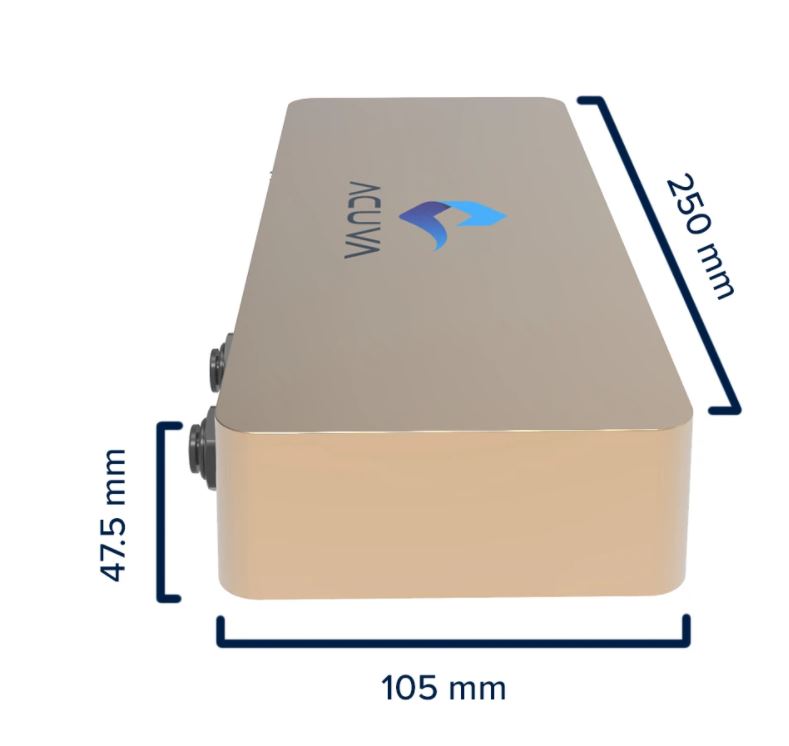
Acuva UV system 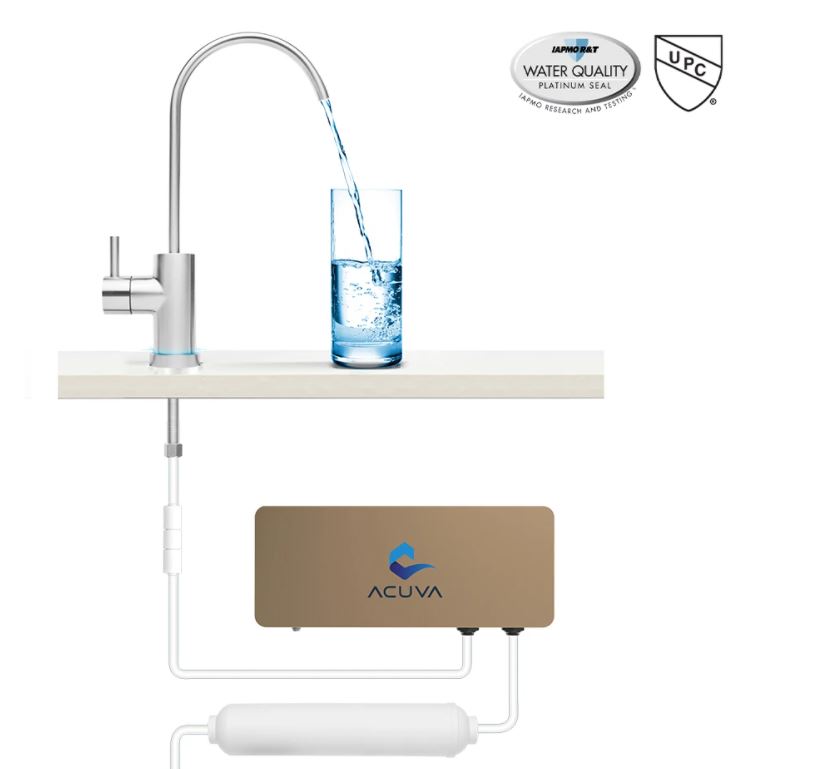
Acuva UV system with pre-filter 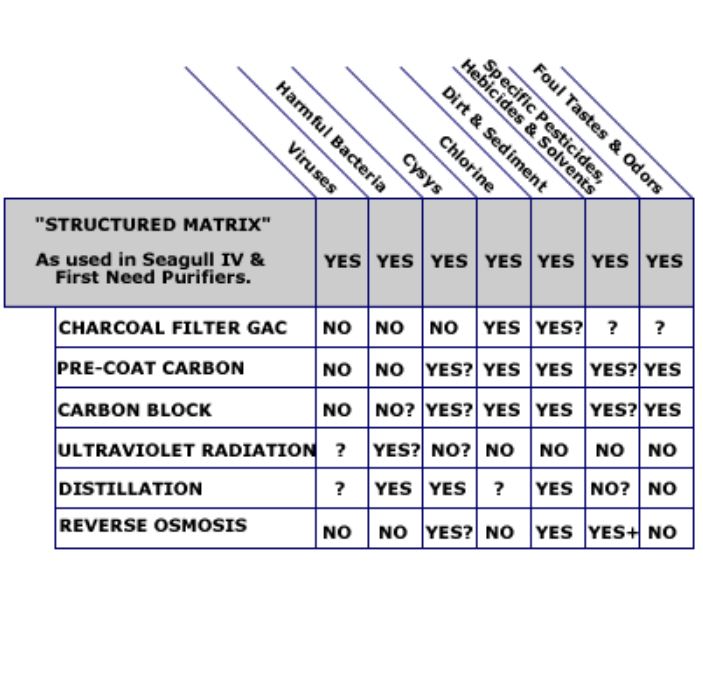
Seagull technology vs. other purification systems
Boat water system schematics
Water being considered as a key system, we apply our redundancy principle. The main system’s output will be circa 100 l/h, and we add a backup system, fully independent, which may have a lower output (30 l/h for instance).
Depending on space available, the backup unit could just as well mirror the main, with a twofold benefit: simplifying maintenance on one hand, and doubling the output when high latitude lower temperature will make it necessary, on the other.

Measuring consumption
In many cases, the tank gauge isn’t reliable – for instance on a heeled long passage. This in when the flow-meter comes in. Many systems exists, from basic battery operated ones to sophisticated models with consumption-level alarms. Working on a catamaran project, with reliable gauges (no heeling), for the purpose of measuring consumption and backing the tank gauges, the most simple models should make the trick.
- Savant DigiFlow has a range of basic flow-meter
- Assured Automation flow meter use a helical turbine to measure accurate flow of cold water
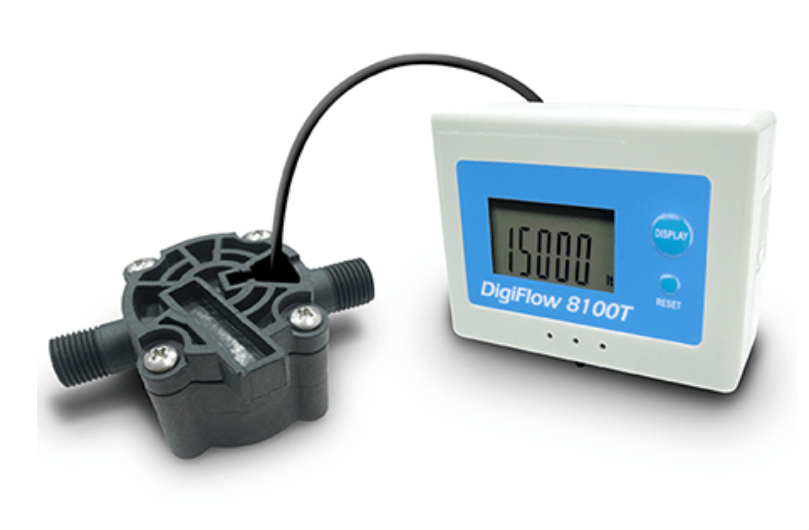
DigiFlow battery operated 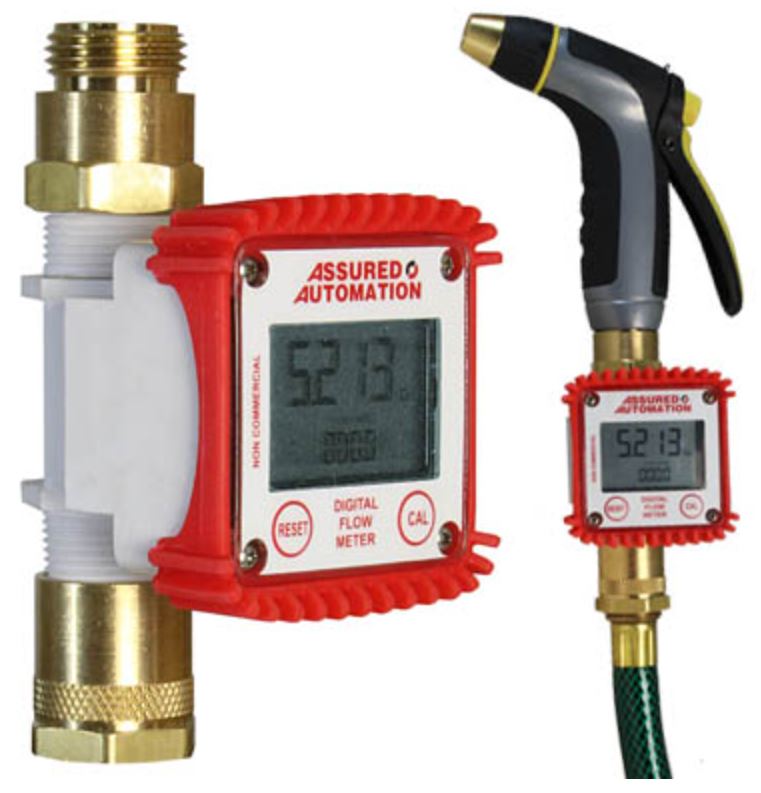
Assured Automation flow meter 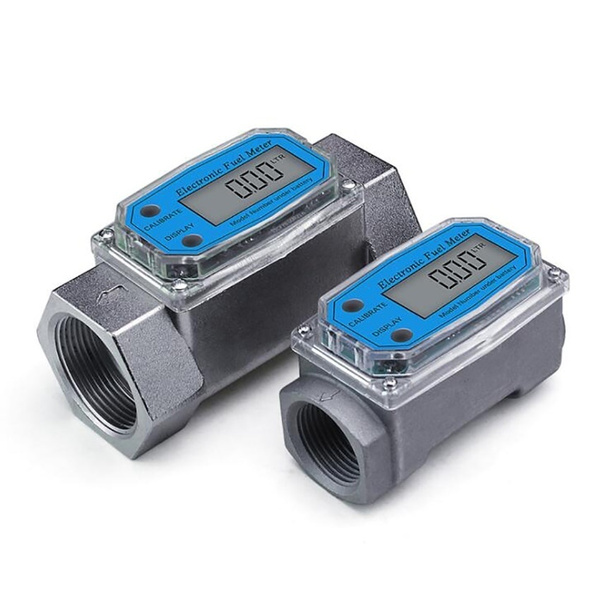
Turbine Water Flowmeter with Digital LCD Display,
Emergency system
In case a boat evacuation is necessary, we plan to add to the grab-bag content a manual water-maker such as Katadyn’s Survivor 35, and this can be a life-saver while waiting for rescue.
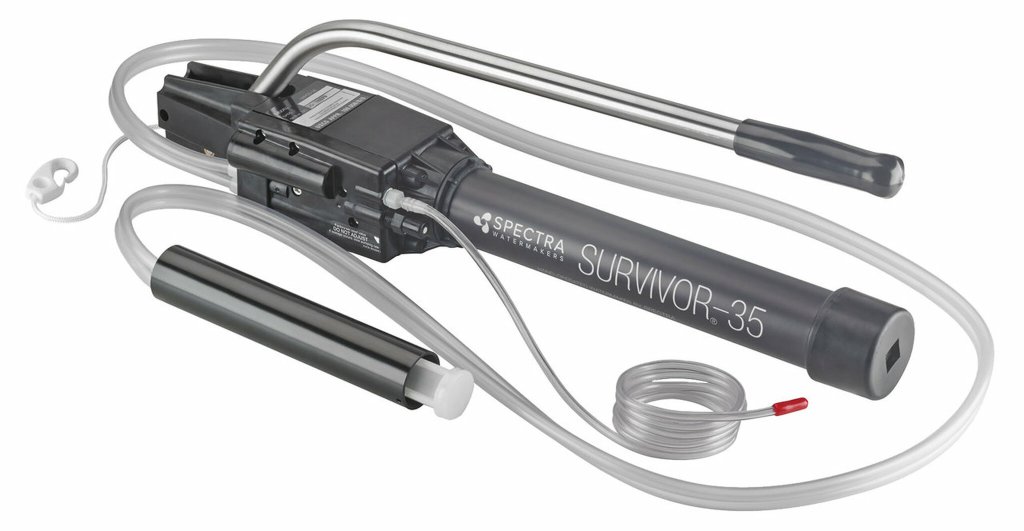
- Salt rejection (avrg) 98.4% (min 95.3%)
- Output 4.5 l/h (± 15%)
- Dimensions 14 x 55.9 x 8.9 cm
- Weight 3.2kg
- Technology Reverse osmosis
Filtering water before filling the tanks
Dockside water is renowned for its bad taste – it travels a long way around the pontoons on its way to your slip, often through very old pipework.
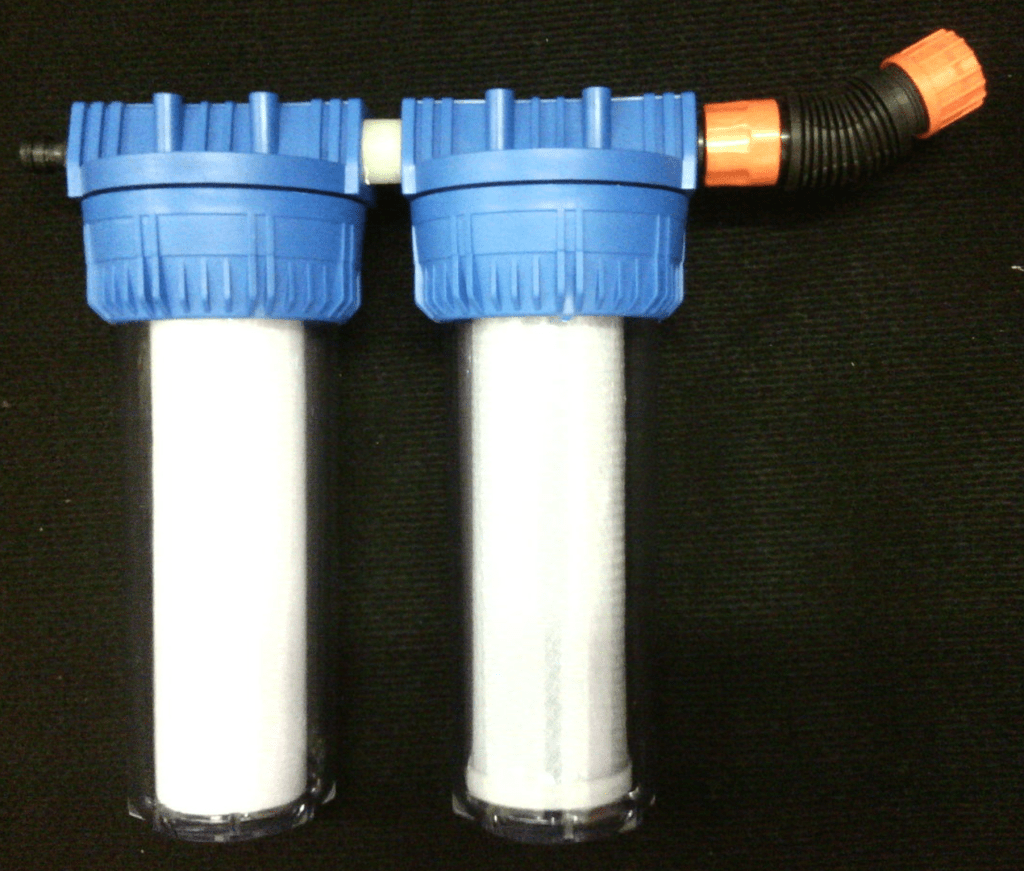
Our preferred system uses a 2 stage 10 inch filtration module, on a standard hose connector:
- Prefilter for suspended debris down to 5 micron
- Charcoal filter to remove smells, chlorine and chemicals from water before reaching the tank.
Appendix
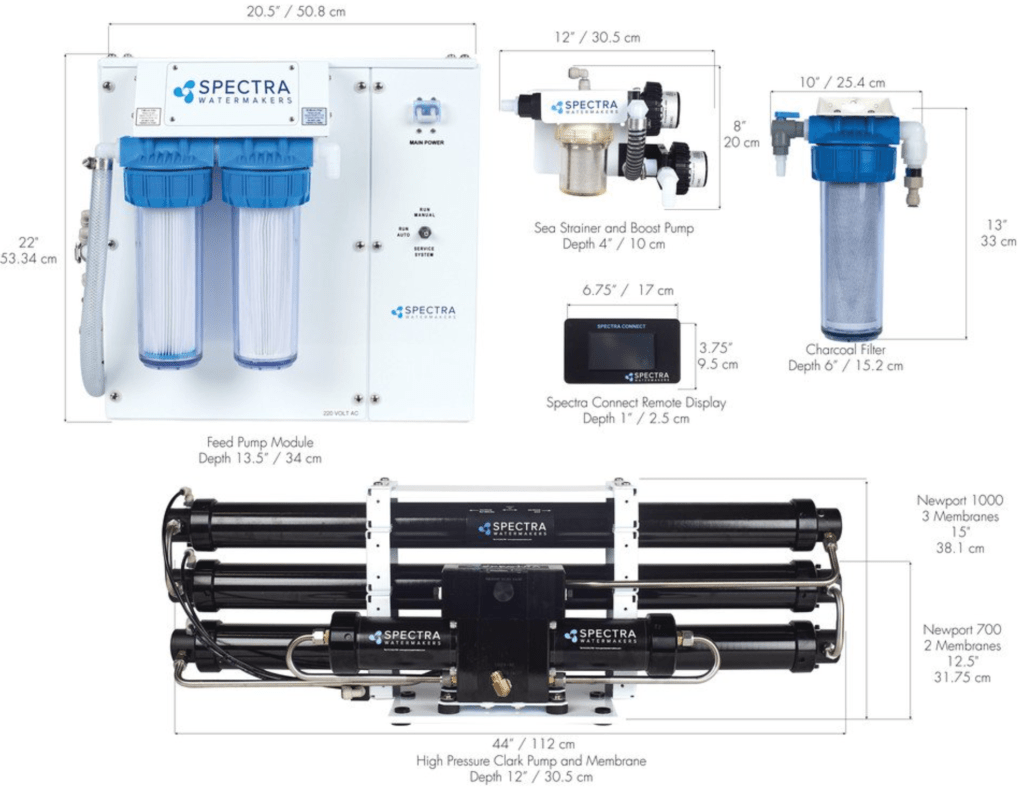
Spectra Newport 700c system sizing
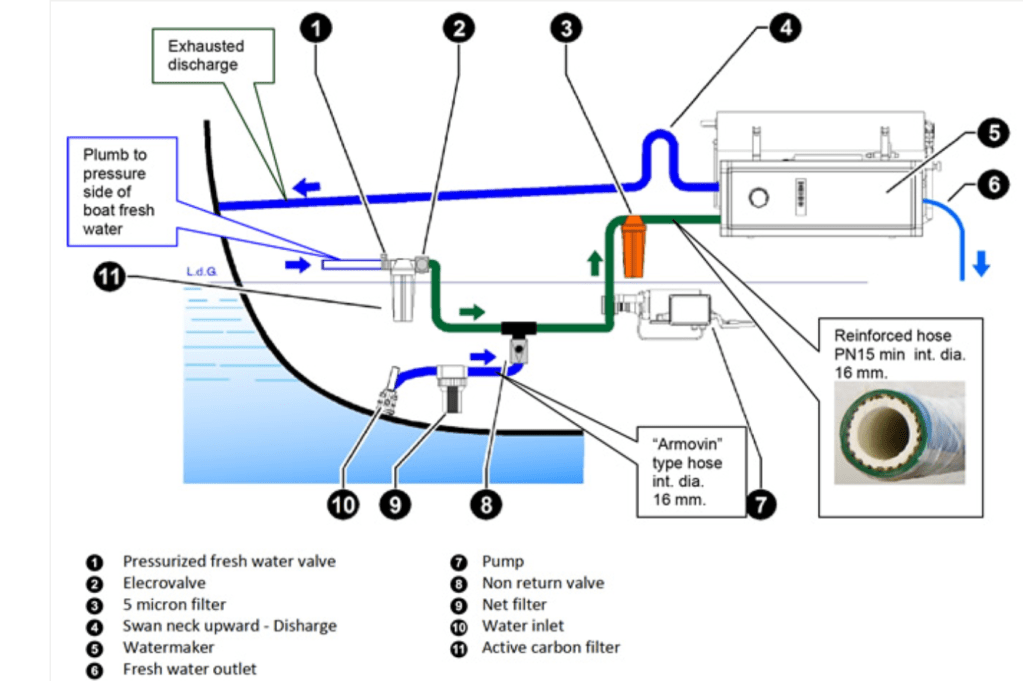
Schenke typical installation
 70th parallel
Avid follower here. Please keep the excellent content flowing!
LikeLike