
For those unfamiliar with The Matrix movie, “The One” is a systemic feature of the Matrix, in which a special code is carried by a randomly selected human being. As such, he possesses vast superhuman abilities as an avatar within the Matrix, in addition to some extraordinary powers in the real world.
Basically, this is what we’ve been looking for in a future boat, with its abilities to satisfy many different projected sailing dreams, but also with extraordinary sailing abilities in thought situations, which would allow for sailing journeys into less than ordinary places.
Based on our experience of mild-climate sailing, we decided to set the bar for high latitude sailing, as this would be the most demanding context. And contrary to most opinions out there, if not to common sense, we were inclined to stay with our current catamaran design, vs. switching for a 55-60 ft monohull.
Introducing Garcia Explocat 52
Well, in all fairness, Garcia should be the one introducing the boat, and their website will provide all the essential informations. As far as we are concerned, we initially checked the key specs online (#1 it’s made of aluminium, and #2 it has two hulls), and then some additional ones which were important to us, directly with Garcia’s senior rep, over the phone and by email, thanks to the covid situation.
One of the advantage of reputation is that it saves time. Even if the company has evolved many time during its nearly 50 years history, Garcia managed to keep along the way what made the success of their first aluminium boats, designed with Philippe Harlé: a long-standing ability to cope with experienced and demanding sailors’ request
The process went very smoothly, with a lot of reactiveness and flexibility. It was soon made very clear that customization would in no way be a problem and that special requests were welcomed, on top of the long list of relevant standard and optional specification. Provided of course they would not alter the boat certification, or modify massively its structure.
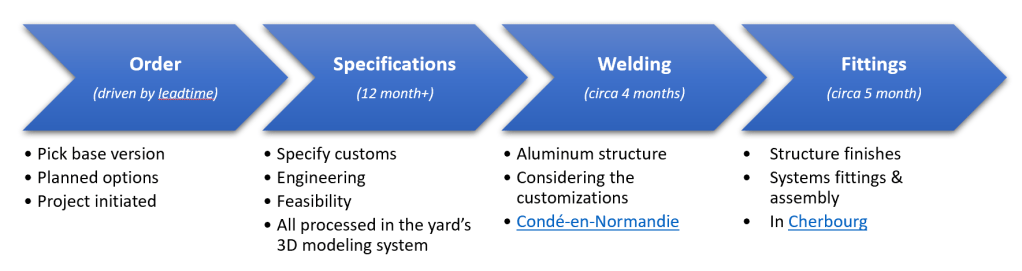
We did have in mind some substantial structural change in the starboard hull, as well as other personal choices on key system layout and choice, and Garcia’s answer was: “if we specify this ahead of initiating the 9 month build process, it’ll be ok“.
We had to take into consideration the lead-time for this boat. At the time of this conversation, hull #1 wasn’t due in the water for another quarter. We were talking about hull #5, with a lead-time exceeding 30 months, and there was more than one party interested in this hull. Missing this slot would have added 9 months to the planned delivery date, so we did sigh-up for the project pretty fast, and as a matter of fact the hull #6 deal was closed by Garcia a couple of weeks after ours. As far as we know, the lead-time on this boat has now risen to three years, putting the yard in the paradoxal situation where its undeniable success seem to be its main development obstacle.
Fitting the purpose
Thinking about sailing program we had already spend quite some time listing the high latitude requirements to be met by the future boat.
| Requirements | Explocat 52 |
|---|---|
| ✓ Reinforced hull construction | 5083 H111 alloy for structure and 6060 T6 for the framings (14mm). Argon welding. The thinnest plating is 5mm, increasing gradually to the very strong 14mm hull bottom. The keel is deeper than the rudders, offering a solid base to dry-out, and there is a protection beneath the propellers |
| ✓ Watertight compartments | Watertight front and rear bulkheads |
| ✓ 3 cabin | On top of the comfortable main cabins, we’re trying to make the Port side peak into a versatile space, mostly workbench (with a vice and all), but on occasion a sleeping area with a small sink. |
| ✓ 3 individual sink & head | option exists, but we decide for 2, making more space for food storage and a regular size washing machine |
| ✓ Thick hull insulation | Standard insulation is 34mm polyethylene, we go for the optional 74mm |
| ✓ Hull space for the redundancy of key systems | – 2 engines, obviously (2 x 75hp) – 2 independent autopilot system, on each hull (rams, pumps, calculator, GPS) – 2 genset, which can work independently or combined – 1 hydronic heating system combined with 1 Refleks fuel stove for heating redundancy – 2 watermakers for redundancy or double output in high latitude waters (output ~60% below 5°C) |
| ✓ Protected watch position | There are 3 steering positions, not accounting for the comfortable chart-table one, perfect for cold weather watch. |
| ✓ Protected space to get in and out of foul weather gear | In a catamaran, the back cockpit is an amazingly protected area, not only to enjoy anchorages, but as well to prepare yourself safely for foul weather. |
| ✓ Fuel tankage above 1500 l. | Standard tankage is 2×500 l, but there is the possibility to add 2×250 l, either for fuel or for grey water. In the short term, aiming for Northern latitude where fuel autonomie is key, we would opt for additional fuel tanks, ready to reverse this in a few years. |
| ✓ Water tankage above 700 l.. | Standard tankage is 2×330 l, and we plan to add a custom-designed 40 to 60 l. drinking water stainless steel tank and filtering system |
| ✓ Storage for sails and spare anchoring | The boat is set with a genoa, a staysail and a 107 sqm main. Starboard peak is huge. Lots of space for an additional Gennaker and a Parasailor. The boat is set with twin anchor positions, on each side of the central beam. We plan to have one main with 120m x 10mm chain, and a backup with 80m x 10mm, meaning 2 identical windlasses installed on deck. There is a locker at the foot of the mast where the backup anchor could be stored. And there is a 3rd anchor at the stern, with a dedicated locker which could also store our Fortress. |
| ✓ Accessibility on all systems and engines | Both engine compartment are very airy. On Port side there would be an additional 5kW Fisher Panda genset, and on the other the Vebasto Hydronic system. There would be 1 watermaker in each hull, and all the water and electric systems are accessible. This is where one can see that not only Garcia has cumulated decades of experience, but they stayed up to date on systems evolutions. |
| ✓ Storage for long range boat spare and real workshop area | A workshop is set into the Port side peak (with heating). But most tools and spare are stored either into the engine compartments, or in dedicated space into the hull. Garcia builds aluminium supports to a standard-size packaging rigid containers, so it’s easy to stack plastic boxes of different shape and purpose. |
| ✓ Food storage for 4 to 6, for over a month | This is where we made the most drastic change. As both peak and engine rooms are so large, the hull living areas end up making the same size our current 45 feet catamaran has. So, we decided to downsize to one head and shower per hull, making space for an additional 180 l fridge/freezer capacity, and a large size washing/drying machine. Our line of thinking is that we will have a crew exceeding 4 on limited occasions. |
| ✓ Space to spare | In a catamaran, this is one of the key benefits, but one needs to keep weight control at all times. |
So basically, this boat checked every main feature we were expecting. And some more. Garcia having a custom-study department, we were able to make a list of changes we would like to make to the standard layout. Some were safety-related, and other were comfort-related. There are a few which would qualify for whims-related.
Main customization at this stage
Safety-related changes
- Two 5kw genset (vs. a larger one), although this is still in discussion. At least the pre-install of the second one. We’ll synthetize the electric production systems in a later note, but it qualifies for the redundancy goal while on a high latitude sailing journey, when solar won’t be delivering.
- Two watermaker, globally a redundancy goal, but also a way to double the output in very cold waters.
- Fuel stove as a back-up heating system (although we like the ambiance as well)
- Dinghy storage under the boom on long passage, instead of davits
Comfort-related changes
- Drinking water installation
- A large couch in the living area, coupled with a smaller table for 6
- Change in the galley cupboard installation
- Dishwasher in the galley (45cm regular one, easy to change)
- All-electric installation, including cooking
Whims-related changes
- Reserving two small spaces with dedicated cat access for its litter box, both inside and outside. Only boat owners with cat will understand.
- Making a hammam/shower area in the Starboard hull, circa doubling the shower space, going from two sink into this very large space to one only, and moving backward the existing deck hatch. A long shot at this stage, but we do appreciate our steam bath now and then (implies: genset + steam boiler + tight door + porthole to let the steam out).
- A movie installation with a large thin screen articulated in the roof of the living area. We are movie buffs, and dropping this while on a long sailing journey is something we’re not ready for.
The list is way longer than these few examples. What’s important is to separate the important custom requirements from the nice-to-have ones. At this stage we’re still expecting for everything, and in fact Garcia’s engineering staff is working on all topics in the lists, but realistically we know we’ll have to drop some of our requests.
Sea trial
Due to the Covid situation, it’s been a challenge for Garcia to maintain the production in 2020. After some initial weeks of disorganization in early Spring, the yard demonstrated its flexibility and its staff’s commitment, and hull #1 was launched nearly as planned. Its initial sea trial took place early summer 2020. We weren’t able to attend to a significant sea-trial yet. Instead, all we can do is take famous British yachtsman Pete Goss’ words for it, as he was lucky to test hull #1 last summer.
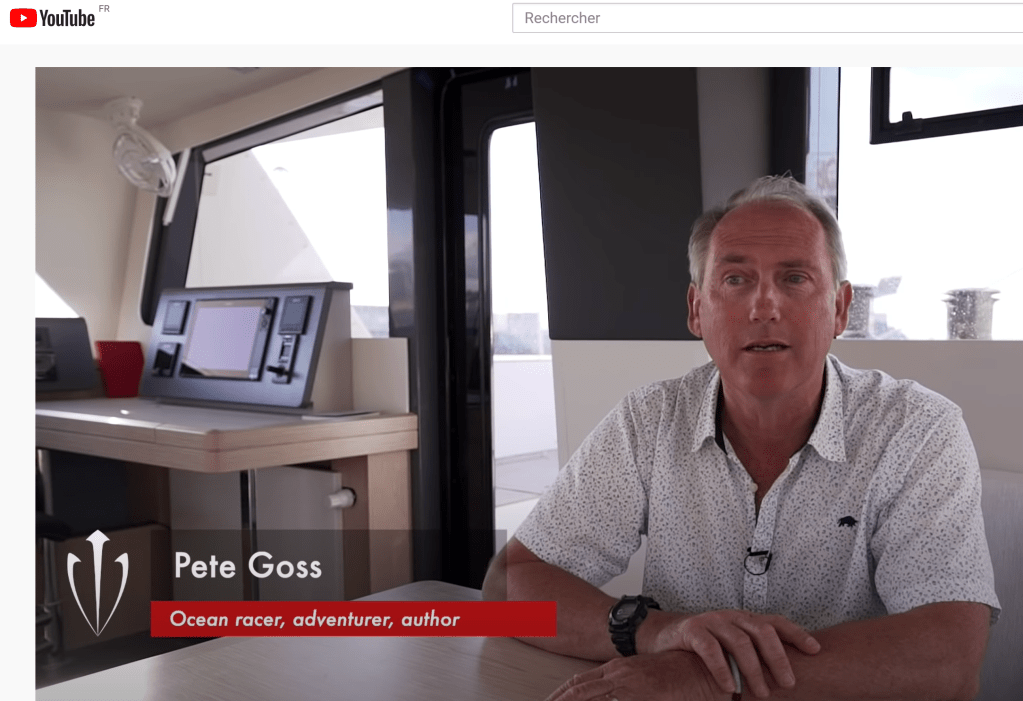
Transcript from the video, his main comments are:
- Easy going
- “Tacks like a dinghy”
- Very stiff and well built
- Same type of game-changer for catamaran, the Exploration range has been for monohull
- Stretches’ up and down the traditional sailing zone of a catamaran
- Rigid structure, in 20-22kn of wind, the shrouds weren’t moving at all (carbon mast on #1)
- Around 12kn all day long, with potential for more
And then we have the Yaching World sea trial which took place in nov.20.
“Our test took place from Cherbourg on a gloriously sunny late November day, with a gusty and shifty southerly breeze varying from 7-19 knots. It’s immediately clear the Explocat 52 picks up and sails at speeds that belie its displacement, putting it in a different league to other expedition yachts of similar length, especially when reaching.
Yachting World feb.23 2021
Broad reaching at 120° TWA with full main and Code 0 in 16 knots of true wind we cruised comfortably at 10 knots, reaching an unfussed maximum of 11.8 knots, with the boat still feeling rock steady.
When the breeze picked up to 19 knots, at the design limit for the Code 0, we furled it and continued with the Solent jib instead, losing only a couple of knots of boat speed. By the time we turned upwind the wind had eased significantly, which gave a good test in conditions that can challenge cruising yachts.
In just 7 knots of true wind we made 5.3 close-hauled, rising to 6.2 in 9 knots of breeze. Maximum upwind speed was 9 knots in 15 knots of true wind. However, these numbers can’t be achieved if pinching – the boat likes to be sailed fast and free, with tacking angles of at least 105°. This is hardly a surprise for a boat of this style that’s sufficiently fast to have a big impact on apparent wind angles.“
This is where we stand at this stage, not having finalized choices regarding rigging, sails, deckware or electronics. We have 6 months to finalize this, before hull construction begins.
 70th parallel