
So that’s how the journey goes on: spending hours on boatyards’ website, all specializing in all-roads aluminium boats, reading blog stories of sailors commenting their choices, good or bad, taking notes of the mistakes they made and the issues they encountered, and how they overcame them. Putting quite a few new destinations on this on-going Google map project of ours.
In the process, we get the feeling that this little venture is getting increasingly popular, not only within the sailing community, but as well for rookie sailors either looking for a radical lifestyle change, or with the digital flexibility to keep working while aboard. In fact, for some millennials, off-the-beaten-tracks seem to be the new normal, and going to Antarctica or through the NW Passage on a sailboat is now on the same list as would be climbing the Kilimanjaro, or the Mt Blanc for the less adventurous ones. So much for the Ravello, Goa and Bali of the previous generations. Not only is the “adventure” or “expedition” boat in high demand, but even such catamarans are now being featured.

At some point there were too many of them, so we started a small database to compare their key specs, such as displacement, sail area, LOA, LWL, and so forth. At the end of the day, apart from the purpose-built one-offs, most of these boats would come out of a handful of boat yards, each with the proven experience for this specific kind of sailing program.

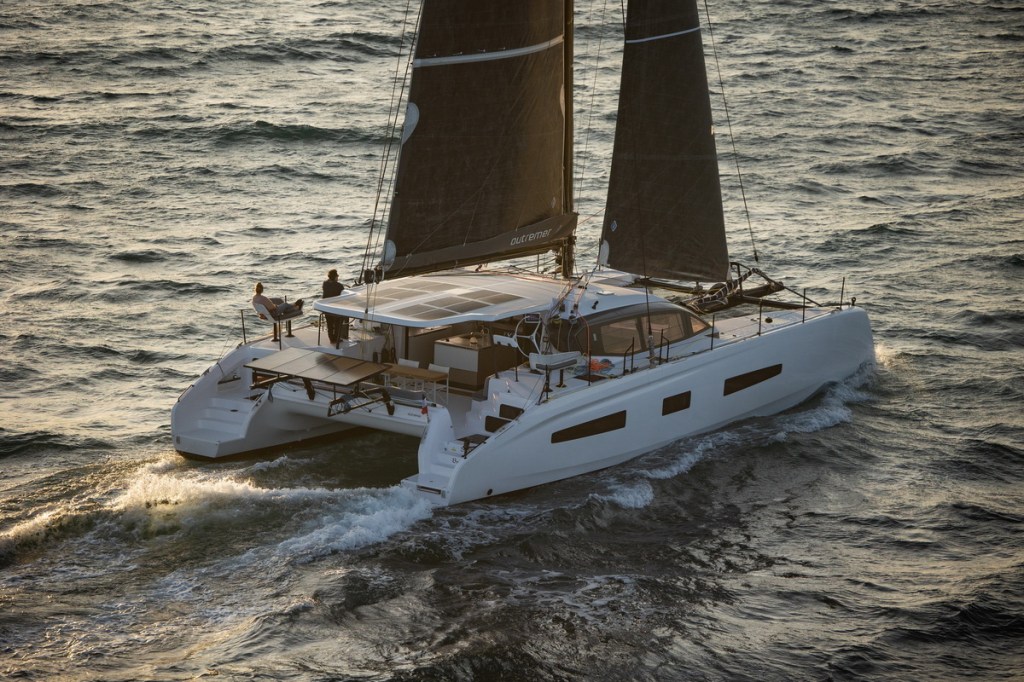
Coming from the composite world with our current catamaran, we included into this table some composite boats as well (Lagoon 55, Discovery 50BW, Outremer 55 and Balance 526), for benchmark purpose, and to validate that above a certain size, aluminium construction, supposedly heavier, is in fact more weight efficient.
In this respect, the Outremer 55 and the Balance 526 are both clear outliers with identical ratios (12.4 sqm/t | 0.8 t/LOA m) and obviously performance-oriented, while the Lagoon 55, launched in 2021, seems more comfort-oriented (and Vaan’s R5 project design-award-oriented).
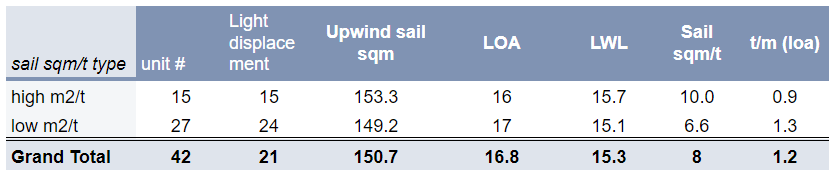
Setting up a 8.5 sqm/t. threshold of upwind sail area, two very different potential performing boats appear, both bearing more or less the same upwind sail sqm (circa 150 sqm), but the leading group being 50% above the lagging in this respect. In terms of t/m (LOA), the leading group is nearly 30% lighter.
We drilled down into the group for which we managed to gather light displacement weight and LOA information, both for catamarans and monohull, per size brackets:

We can see that in the 15-17m LOA range (19 boats in this benchmark), catamarans are 4% lighter compared to their monohull counterparts (that’s for both hulls of course :-), but bear 9% more sail sqm (14% more sqm/t) for equal LOA, all metrics which relates into some speed advantage under sail. We’d love to have the wetted surface to rank them in regard to light wind conditions, but this information is harder to get.
Now, only keeping the aluminium production within the <17m LOA range with relevant data (30 units in this benchmark), we can see that catamaran and monohull have nearly the same LOA, 9% lighter displacement for the 7 catamarans, but these bearing 7% more sail sqm (15% more sqm/t).

And if we focus on all 11 catamaran in this <17m group, 7 aluminium and 4 GRP, we notice that the aluminium ones will be lighter (adjusted with their size), and this is despite the Outremer 55 and Balance 526, which are both very light at 0.8 t/m.
It seems that above a size threshold which we estimate between 45 and 50 feet, aluminium construction looks like the wise choice for a rugged all-road catamaran. Of course while we can check that Garcia’s Explocat 52’s bells and whistles compares with Balance’s, Lagoon’s or Outremer’s, it’s impossible to do so with the Ovnicat 48, the Eyecat 55 and the Coast 50, for which we couldn’t read any detailed specifications above their basic design information.
So, as one seems to convincingly appear in this benchmark, is there the off-chance that a catamaran could fit an adjusted high latitude program ?
Architect, yards & boat references
All in all, we reviewed over 50 boats within our size brackets and with off-roads or even advertised high latitude features. Along the way, it appeared the top four (KM, Garcia, Boreal and Alubat) seemed to suit our needs best.

Featured boats
- Atlantic 51 – Aluminium built to order cruiser with lifting keel and double rudders.
- Besteaver (by KM) – Each of them is fitted to to client’s specs, so there aren’t one alike the other. All of them share high latitude sailing characteristics.
- BM53 DS – Cruiser with lifting or fixed keel and deck salon, one in a large range of Berckemeyer design.
- Boreal 55 – In a range starting with 44 feet, this 55 feet model launched in 2020 seems like a good compromise between long range autonomy, safety and comfort.
- Coast 50 – An aluminium catamaran designed by Philippe Renaudeau in France, and built in Spain by Mint shipyard.
- De Villiers 525 – The smaller version of the 62ft Alloy Ketch Catamaran which has covered over 100k nm as an expedition boat.
- Enduro 54 – 54′ aluminium sailboat with lifting keel and pilot-house
- Exploration 52 – From Garcia, an upsized version of the famous Exploration 45, co-designed with Jimmy Cornell. But now, there is the Exploration 60, due in 2021, as the real upsized version.
- Explocat 52 – From Garcia, launched in 2020. All the famous boatyard DNA in twins hulls.
- Eyecat 55 – An aluminium one-off catamaran, delivered in the summer of 2021, aiming for larger industry footprint.
- Icebird – Purpose-built by Trintella shipyard (disc, Netherlands) this Van de Stadt 61 is fitted for high latitude conditions and ice, with Aero-rig sail setting.
- La Louise – 19m wood/epoxy/glass fiber/kevlar schooner, launched in 2010 (french only)
- Nanuq – 60 feet Grand Integral, designed for minimal environmental impact, launched in 2014.
- NanuQ (by KM) – 24m polar explorer launched in 2019 and designed by Dykstra.
- Noordkaper 56 – The largest unit in a range from 40 to 60 feet. It’s a steel cutter, long keel design, with lots of storage space.
- Northabout – 16m Bermudan cutter, designed by Caroff Duflos and launched for polar sailing in 2001
- Puffin 58 – The largest of the aluminium Puffin range, which was remodeled in 2021.
- Qilak – 20m Sealium sailboat built by KM and designed for polar regions
- Vaan’s R5 catamaran project
- Seal – A 56 foot aluminum sailboat to explore high latitudes and support scientific and adventure expeditions, designed by Chuck Paine and Ed Joy
- Stern 60 – (“Pooh”) Designed by Bosgraaf, custom built by de Sluis Jachtbouw.
- Vagabond – 47 feet polar yacht designed by Gilbert Caroff.
- Vinson of Antarctica – 77 feet expedition yacht designed by Tony Castro for Skip Novak, of Pelagic Yachts, and launched in 2021.
- Why – 20m aluminum schooner, by Underpole expeditions
- (…)
Yards and designers
- Alubat (France)
- Atlantic Yachts (Netherlands)
- Berckemeyer Yachts (Germany)
- Boreal Yachts (France)
- Bosgraaf yacht design (Netherlands)
- Coast catamatan (France & Spain)
- De Villiers Marine (New Zealand)
- Dikstra naval architect (Netherlands)
- Ed Joy design (USA)
- Enduro (France)
- Eye catamaran (Netherlands)
- Futuna Yachts (France)
- Garcia Yachts (France)
- Kanter Marine Yachts (Canada)
- KM Yachbuilders (Netherlands)
- Meta Yachts (France)
- Puffin (Netherlands)
- Trintella shipyard, disc. (Netherlands)
- Vaan (Netherlands)
- Yacht Holland (HISWA Orange Yachting Group, Netherlands)
- (…)
- Finally … Splash!
 It’s been a long time, ans there has been questions alongContinue reading “Finally … Splash!”
 - Building to first splash
 Well … it’s been a while since we initiated this project.Continue reading “Building to first splash”
 - Energy production systems
 While we’d agreed that boat life has to be more frugalContinue reading “Energy production systems”
 - The One
 For those unfamiliar with The Matrix movie, “The One” is aContinue reading “The One”
 - Water, not plastic
 Everyone will agree over the fact that single use plastic isContinue reading “Water, not plastic”
 - Insulation and ventilation
 Nanuq is a 60 feet Grand Integral launched in 2014 andContinue reading “Insulation and ventilation”
 70th parallel