
There will be as many autonomy approaches as there are sailors to describe it. It starts with the Skipper who is able to perform any repair in any system of his boat, electrical or mechanical, all by Nigel Calder‘s finest standards. On the opposite, there would be the one who’s best ability would be to perform the online search of the nearest skilled helping hand.
That’s the point with high latitude sailing: the nearest helping hand might be many days away, with no DHL/UPS drop.
Sitting in between like most, we had to think in terms of some repair ability, but also in terms of redundancy of all key systems. And of course keeping in mind that an unused system is prone to failure when precisely one needs it.
Key system redundancy
| Engines | Over a decade and 23.000 miles, with regular engine maintenance, we’ve had 3 failures. Once, a cooling system water pump had a leak and we had to do with the one engine left. The other two failures were related to dirt in the fuel pre-filter system that were difficult to detect. Have you ever tried to set in motion a catamaran with one engine? Well, it’s not a situation you like, especially when sitting near obstacle, but after 2 to 3 boat lengths, you recover steering control. In each of these situation, we were quite happy with the 2nd engine helping us to reach a repair spot. |
| Water | Our boat is fitter with a Dessalator Duo water maker. It provided 60 to 80l./h flawlessly, with very little maintenance. Only once did it fail us, when a corrosion-related leak appeared on one of the high pressure plugs. There were only two of us on board, we where in the Aeolians. The tech was in Ischia, 120 nm North. We solved the issue in a couple of days and we had a nice early breakfast in Capri along the way. What if it happens with a full crew, far away from any logistical support? |
| Heating | In temperate latitudes, heating can be optional depending on everyone’s lifestyle. Some would put a 220v radiator while on shore electricity. Others would have a heat blowing system fitted such as Eberspaecher‘s quite popular ones. Sailing at high latitude implies the ability to sustain very cold temperature for long periods. And it’s not always a question of personal confort. That’s clearly a key system we weren’t familiar with which we wanted to be as secure as possible. |
| Energy | There has been quite some changes in our sailing energy needs since I started sailing. Back then, my college friend dad’s Jeanneau Melody was fitter with four 6V batteries. Today’s requirements will again vary from one to the other, as not everyone is Bernard Moitessier or whishes to go back to the 70’s. But if you want to keep your options open, to invite working crews (or just their kids), to have lots of cold-storage capabilities, redundant electronic systems, well, if you’re heading in this direction, being a little spoiled by modern habits and comfort, energy production and storage is a key element of your autonomy. |
| Dinghy & outboard | For most, this one isn’t exactly a key system of the boat. However, when in a remote area with no other way to reach the shore, a powerful and reliable outboard engine is indeed quite essential. Rowing a loaded dinghy against strong winds is a venture no one wishes to try. And high latitude remote anchorages will make whole new dinghy experiences very common, such as tying the boat on long shore lines as quickly as possible, when anchoring isn’t an option. Plan for more outboard HP for this exercise, and for a solid bottom dinghy, as it will meet with rocky shores more than once. Being so essential to the boat’s life and safety, having a backup inflatable dinghy, and switching between two similar outboard engines (spare and maintenance optimization) seems like a safety requirement. |
| Sails & Rigging | That’s the main engine of the boat. I’ve had a mainsail torn out once in a squall. Just below reef two, so we were able to continue to a harbor and organize the repair. Another time the Genoa furler was jammed with mal-practice, and that could have resulted with some serious damage, should the wind grow stronger. High latitude sailing means precisely high and more sudden winds, especially in the South. While working hard to prevent any damage in the sail and rigging system, working on some redundancy and repair capability in this area is a key goal. |
| Anchoring | Our boat was fitted on delivery with a 25kg Spade anchor and 80m of 12mm chain. In the Med, anchored by the book, we did drag a few times too many, and we switched to a Rocna 40kg. This one never failed us … until we lost her in the weed, when its attachment D-shackle broke while getting her out of the water. Unable to retrieve her in the weeds, we were quite happy to set back the initiale Spade which was kept as a spare. And we also have a 25kg Fortress. which was never used until now. Another time, the windlass failed us. Retrieving the 40kg Rocna in a 10m anchorage by hand — in fact using a set of DIY line system running from the front to a main winch — was only possible with helping hands. And the conditions where perfect, no wind, no sea. In Santorini, we were in a situation were anchoring wasn’t an option, with shores quickly running down to depth exceeding reason. We had to use a 100m Dyneema lines to tie ourselves to the shore on one side, and to a big floating ton on the other. High latitude will be more demanding in all of these respects. |
| Autopilot | We sailed our 23.000 miles with a 2013 Raymarine spx30 autopilot combined with a Lacombe hydraulic drive unit, and it failed us only once. On this occasion, being alone on board, I was happy that we had installed a fully independent spare system, with its own GSM, calculator and drive unit. A toggle switch is used to activate the backup while deactivating the main – one can easily see the problem with two active autopilots trying to override each other. |
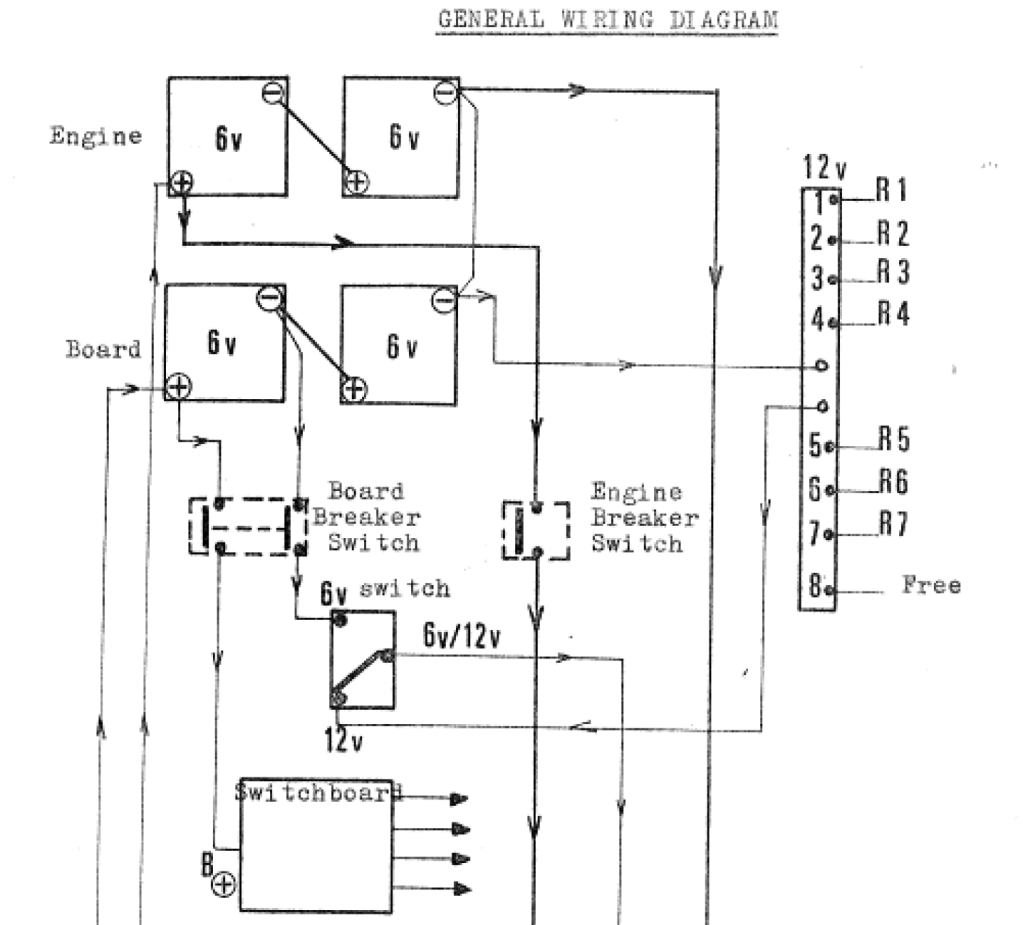
Energy systems have evolved since our early sailing days on a Jeanneau Melody (see electric diagram). Not only are the boats and crew using more electricity, but they have developed many ways of producing it, and Lithium technology batteries, which appeared in the late 90’s on racing boats are now increasingly affordable, thanks to the electric transport revolution and their inherent benefits: 5x more cycles than their classic AGM counterpart, high discharge acceptance, higher charging current (50amp+), higher density, just to name some.
But that’s not the end of it.
Autonomy equally means storage capabilities. We’ve seen about energy storage, but there are fuel and water as well, and food, and spare parts for all those systems, and tools to work things out when necessary.
Food
Imagine what a 30 days food autonomy for a crew of 6 means in terms of meal preparation and food storage. It’ll be a mix of freezer and fridge capacity, as well as fresh produce storage. The good news is that high latitude provides nearly limitless amounts of cold storage. In any case, it is clear that more fridge/freezer capability than for our regular cruiser will be needed over time. Recent systems are now quite energy efficient, and would even have the option to decide whether to set them on fridge or freezer position. And while still in the food department, what canned food would you store on top of all this for the event that the freezer fails you?
Fuel
In the Northern high latitudes, say from Norway to Iceland or Svalbard, motor sailing for extended periods can happen in summer time. When wintering in cold places, a running heating system might be pumping fuel at a 1 to 3 l./h rate, and some will use energy as well (ducked heated air, or water radiator circulation). And how about heating some shower water now and then? The way to compute this into a high latitude boat seems to be “how many days of fuel autonomy?” and “how is this compatible with the motoring distance to the next fuel station?”
This is why current sailing boats in these areas either have disproportionate fuel tank capacity, or temporary add racks of plastic tank and their deck, with the stability impact to deal with.
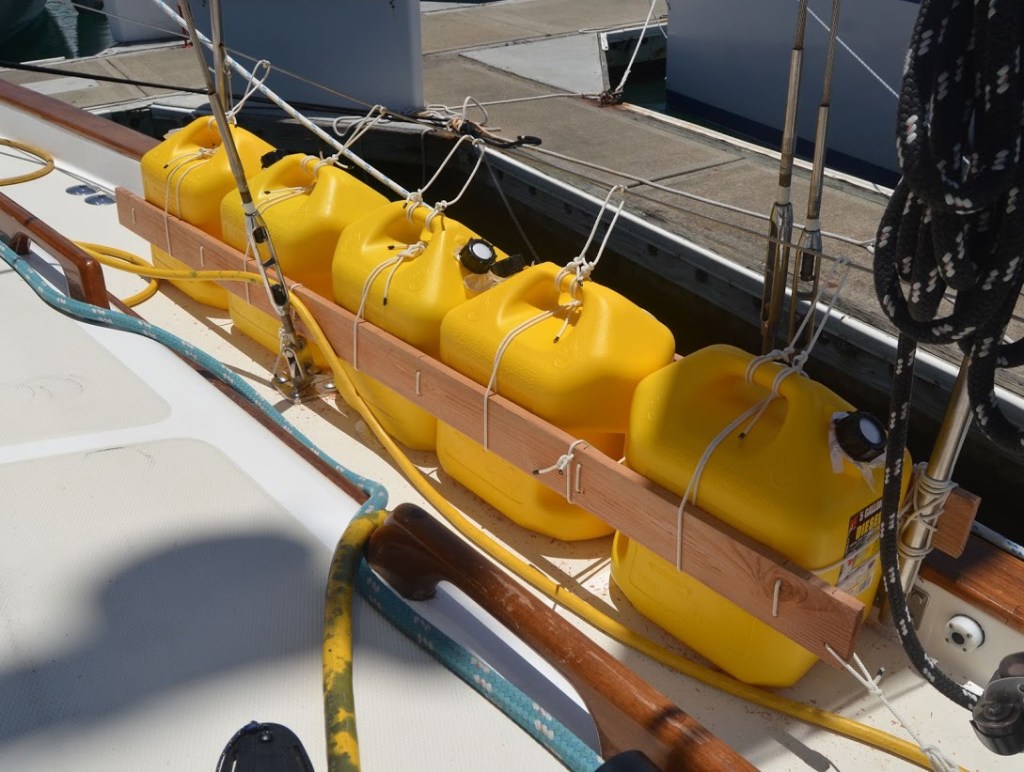

42 feet s/y Adamastor
For what it’s worth, we collected fuel tankage and HP data for about 30 boats we reviewed. The aluminium group has an average fuel capacity of 17 l/hp, 30% higher than their composite counterparts. And doing the same math within the catamaran group, the aluminium ones would carry an average of 30 l/hp, 80% higher than the composite group average. Given the catamaran is supposedly more fuel efficient, at least in low wind conditions, with their ability to run at 65-70% nominal speed on one engine only, would this give them an edge against their monohull counterparts?
Water
Regarding water, the equation isn’t the same as for fuel, as there are ways to fill-up the tanks along the journey, even if some will require fuel (running a water maker or melting ice does use quite some energy). In the South, collecting water from the frequent rain showers should be an easy way to refill, and some large coach-top areas could be set to do this easily. Otherwise, water is a scarce resource and attention to consumption and storage should apply as well.
At a constant pressure rate, a reverse osmosis watermaker production will decrease drastically as does sea water temperature. With a water temperature of 5°C, output could be half the nominal one.
And regarding drinking water, It is not unusual to set the watermaker circuit with a set of remineralizing filter system, although this is mostly a question of taste, as most of our minerals come from fruits and vegetables we eat.
So, to summarize it all, a high latitude boat should cope with the highest standard of reliability and/or redundancy for all it’s key systems, provide an abundant storage capacity to operate and repair whenever necessary, and care for the crew for an extended period of time. But not become prone to overweight in the process, as this would impact its sailing capabilities in the northern light winds. It should as well be strong like a tank, but again not too heavy.
Trying to find the right compromise between these three paradoxical injunctions is where the initial challenge starts.
 70th parallel